
Pyrolytic Graphite
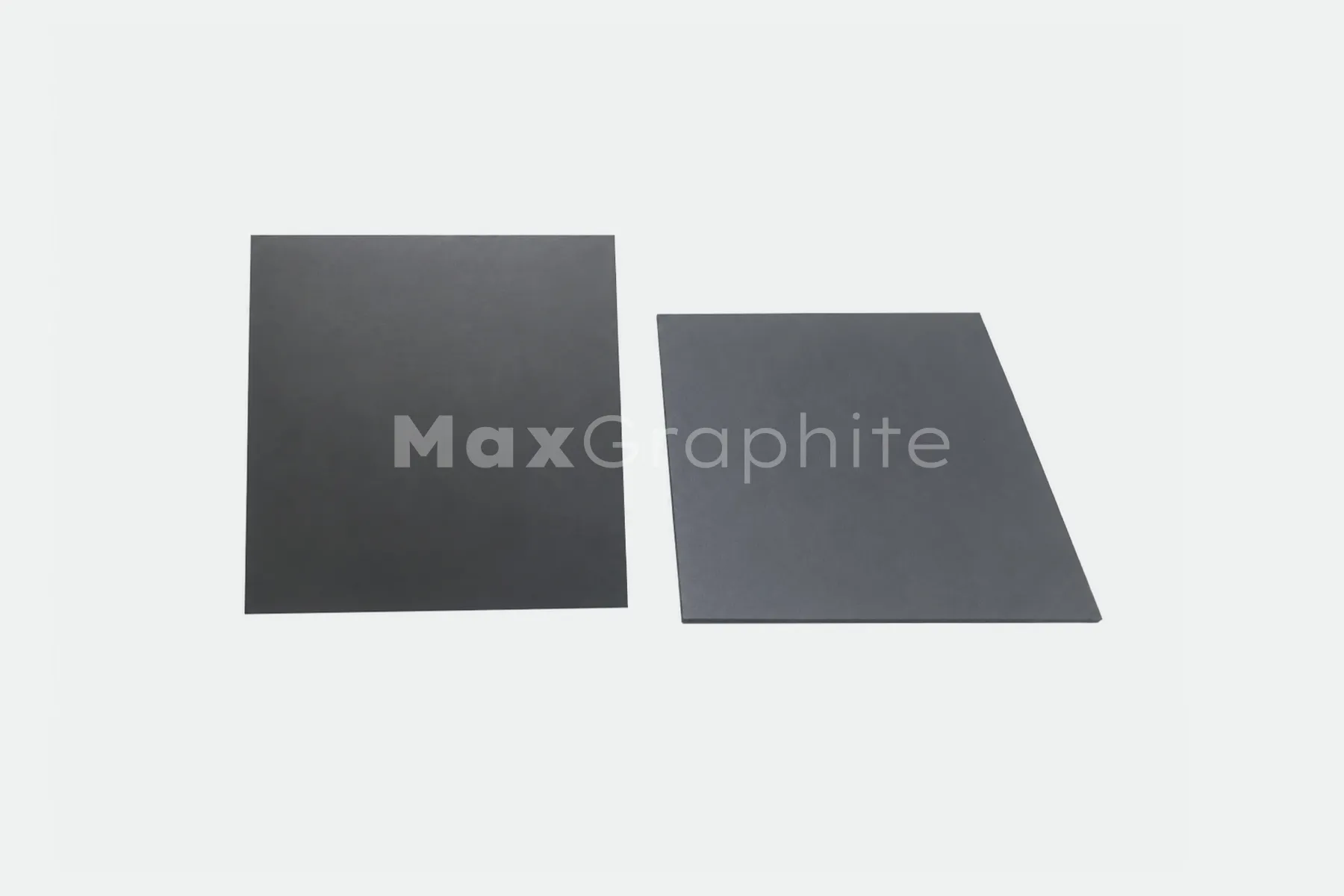
Max Graphite supplies pyrolytic graphite (PG) to engineers and procurement teams operating in thermal management, aerospace, electronics, and broader high-temperature engineering industries, where directional thermal conductivity, surface purity, and structural performance are direct application variables. PG is grown by chemical vapor deposition at elevated temperatures, producing a free-standing carbon material with a highly oriented crystal structure — delivering exceptional in-plane thermal conductivity, low gas permeability, and chemical inertness across demanding service environments. We supply pyrolytic graphite in plate, disc, tube, and custom machined geometries, including higher-orientation grades where refined crystallographic alignment is required. Material grade, dimensional envelope, and finished part configuration are specified per application and supplied across qualification builds and recurring production volumes.
What is Pyrolytic Graphite?
Pyrolytic graphite is a high-purity carbon material produced by the thermal decomposition of hydrocarbon gases onto a substrate at high temperature, building up a free-standing material with a highly anisotropic, layered crystal structure aligned parallel to the deposition surface. This structure gives PG exceptional in-plane thermal conductivity, low through-plane conductivity, and electrical and mechanical behavior that differs sharply between the two axes. Higher-grade variants undergo additional thermal annealing to refine crystallographic alignment and improve performance in precision applications. Max Graphite supplies pyrolytic graphite across the full range of grades, geometries, and machined configurations used in thermal, electronics, aerospace, and high-temperature engineering applications.
Properties of Pyrolytic Graphite
- Anisotropic thermal conductivity — Exceptional in-plane heat transfer paired with low through-plane conductivity, enabling directional thermal management not achievable in isotropic materials.
- High purity — Carbon deposited from high-purity precursors, free of the metallic and crystalline impurities common to bulk synthetic graphite.
- High-temperature stability — Stable in inert and reducing atmospheres at temperatures well beyond the service range of most engineering materials.
- Low gas permeability — Dense, oriented crystal structure resists gas migration through the material.
- Chemical inertness — Resistant to a wide range of reactive gases, halogens, molten metals, and corrosive process atmospheres.
- Highly oriented crystal structure — Layered carbon planes aligned parallel to the deposition surface, the source of PG's directional thermal, electrical, and mechanical properties.
- Diamagnetic behavior — One of the most strongly diamagnetic carbon materials available.
- Higher-orientation grades available — Annealed variants with refined crystallographic alignment supplied where precision performance is required.
Applications
- Thermal management — Heat spreaders and thermal components for high-performance electronics, optoelectronics, and high-power systems.
- Aerospace and defense — High-temperature structural and thermal components for aerospace, defense, and propulsion environments.
- Electronics and semiconductor — Components and substrates for high-purity, high-temperature electronics manufacturing and assembly.
- High-temperature industrial processing — Fixtures, components, and consumables for elevated-temperature furnace, vacuum, and inert-atmosphere processes.
- Crystal growth and high-purity melts — Crucibles and melt-contact components where ultra-high purity and chemical inertness are specified.
- Precision and research applications — Higher-orientation grade material for research, analytical, and precision surface applications.
Related Materials and Products
Isostatic Graphite