
Porous Graphite
Max Graphite supplies porous graphite to manufacturers operating in semiconductor, heat treatment, and broader high-temperature process industries, where controlled permeability and dimensional stability are direct process variables. Our range spans fine-pore to coarse-pore grades, supplied as isostatically pressed billets, machined plates and rods, or fully finished components — at prototype, qualification, and serial production volumes. High-purity treatment and tailored porosity classes are available across the range to match crystal growth, vacuum handling, gas distribution, and metal degassing requirements. Every grade is produced with consistent pore architecture and impurity control suited to the most demanding furnace, deposition, and crystal growth environments.
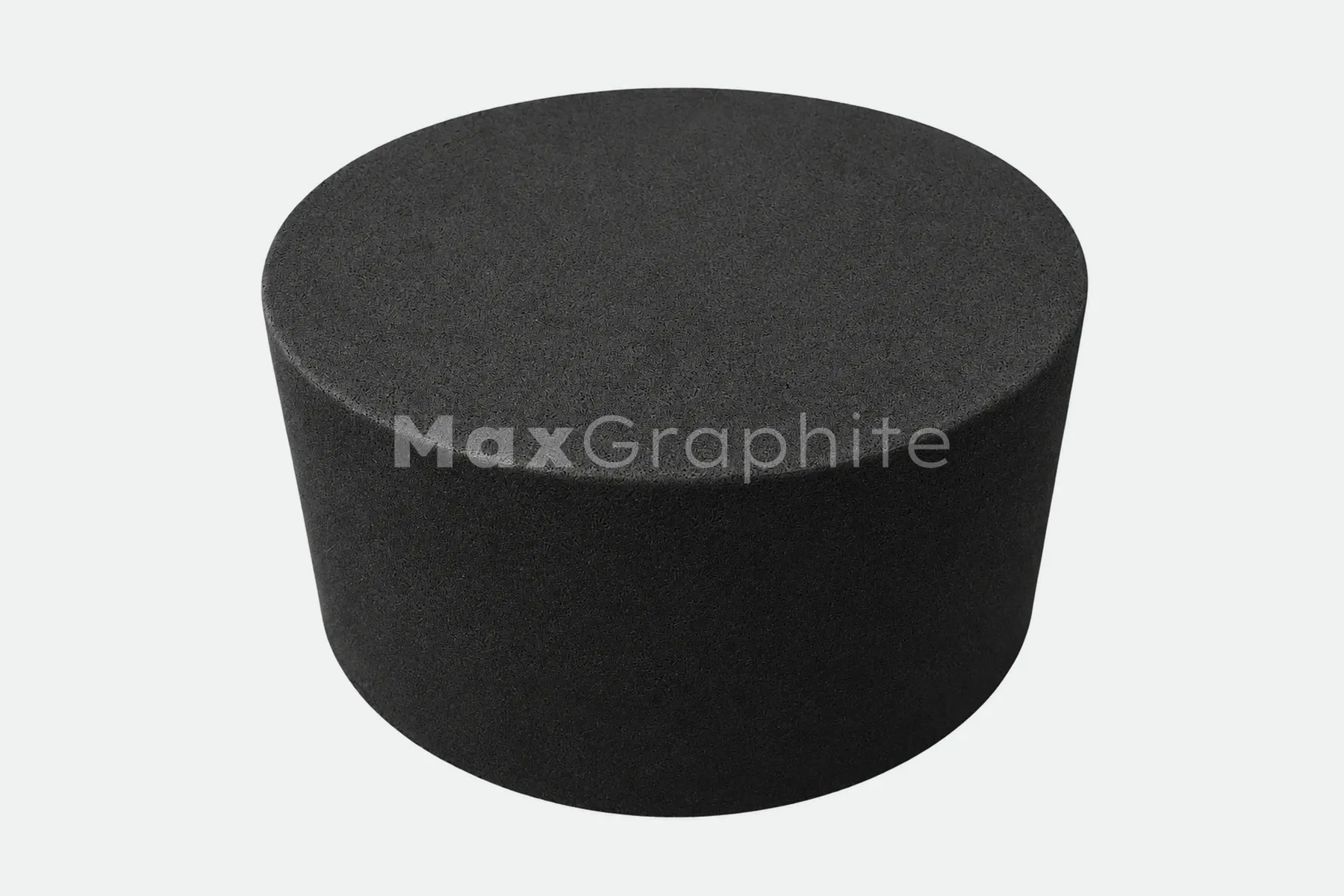
What is Porous Graphite?
Porous graphite is an engineered carbon material with a controlled, interconnected open-pore network that combines graphite's thermal stability, chemical inertness, and conductivity with permeability to gases and liquids. Pore size, distribution, and bulk porosity are tuned during forming and graphitization to deliver application-specific permeability and surface characteristics. Max Graphite produces porous graphite across the full porosity range — from fine-pore grades for precision air bearings and vacuum substrates to coarse-pore grades for degassing and filtration — with optional high-purity treatment for semiconductor and crystal growth environments. Component supply extends from raw blocks through to fully machined, application-ready parts.
Properties of Porous Graphite
- Controlled Open Porosity — Interconnected pore network engineered to deliver predictable permeability for gas, liquid, and vacuum applications.
- Dimensional Stability at High Temperature — Retains form and mechanical integrity in vacuum, inert, and high-temperature furnace environments well beyond the limits of metallic alternatives.
- Chemical Inertness — Resistant to most acids, alkalis, and aggressive process gases, supporting use in semiconductor, chemical, and molten metal environments.
- Thermal Conductivity — Conducts and distributes heat efficiently, supporting uniform temperature fields in crystal growth, deposition, and heat treatment processes.
- Electrical Conductivity — Maintains conductivity through the porous body, enabling use as a heated or electrically active component.
- Machinability — Machines cleanly to tight tolerances and complex geometries without compromising pore structure integrity.
- Purity Tunability — Available in standard and high-purity grades with controlled impurity profiles for semiconductor, SiC, and compound semiconductor applications.
- Tailored Pore Size Distribution — Pore diameter and distribution can be specified to suit airflow, vacuum, infiltration, or filtration requirements.
- Low Outgassing — Suitable for vacuum and ultra-clean environments when supplied in purified grade.
- Impregnation Compatibility — Open porosity accepts secondary impregnation with resins, metals, or pyrolytic carbon to produce hybrid structures with bespoke properties.
Applications
- Semiconductor SiC Crystal Growth — Porous graphite plates and components used in PVT crystal growth to deliver uniform temperature gradients and stable carbon supply for high-quality SiC ingots.
- Heat Treatment Furnace Components — Gas distribution plates, hot zone parts, and process components engineered for vacuum, inert, and reducing atmosphere heat treatment.
- Wafer Vacuum Chucks — Substrate handling components for semiconductor and solar wafer processing, where uniform vacuum distribution prevents point loading on thin substrates.
- Aerostatic (Air) Bearings — Precision-machined porous bodies for high-RPM, high-precision spindles in metrology, machining, and semiconductor inspection equipment.
- Molten Metal Degassing — Rotors, shafts, and diffusers for aluminum and non-ferrous melt treatment, where fine bubble dispersion improves metal cleanliness.
- CVD and MOCVD Gas Distribution — Porous showerheads and diffusers for uniform precursor delivery in thin-film deposition processes.
- Filtration and Separation — Filtration media for corrosive chemicals, molten metals, and high-temperature gases where chemical inertness and dimensional stability are required.
- Electrochemical Substrates — Electrode and current collector substrates for high-temperature electrochemical and fuel cell systems.
Related Materials and Products
Isostatic Graphite